
AI for Funeral Homes: Questions Every Owner Should Ask
Artificial intelligence is generating considerable attention across the business world. Funeral service is no exception.
For funeral home owners and cremation provider managers, however, the important question isn’t simply which AI tool is the latest or most impressive.
It’s a more practical question:
What can artificial intelligence actually do to help us operate our businesses, serve families, and prepare for the future?
That question deserves an informed answer grounded in the realities of funeral service.
AI has potential applications in administrative work, staff training, marketing, communication, and pre-need follow-up. But understanding the possibilities also means recognizing the limitations, risks, and responsibilities associated with these technologies.
The challenge for funeral business leaders is deciding what deserves attention today, what requires further evaluation, and what can safely wait.
Want to walk shoulder to shoulder in this AI and Funeral Service journey?
As mentioned in the webinar, I have created a membership website where my team and I can share resources and answer questions for you.

Claim your spot now:
The founding price ends November 30, or as soon as 20 funeral homes join.
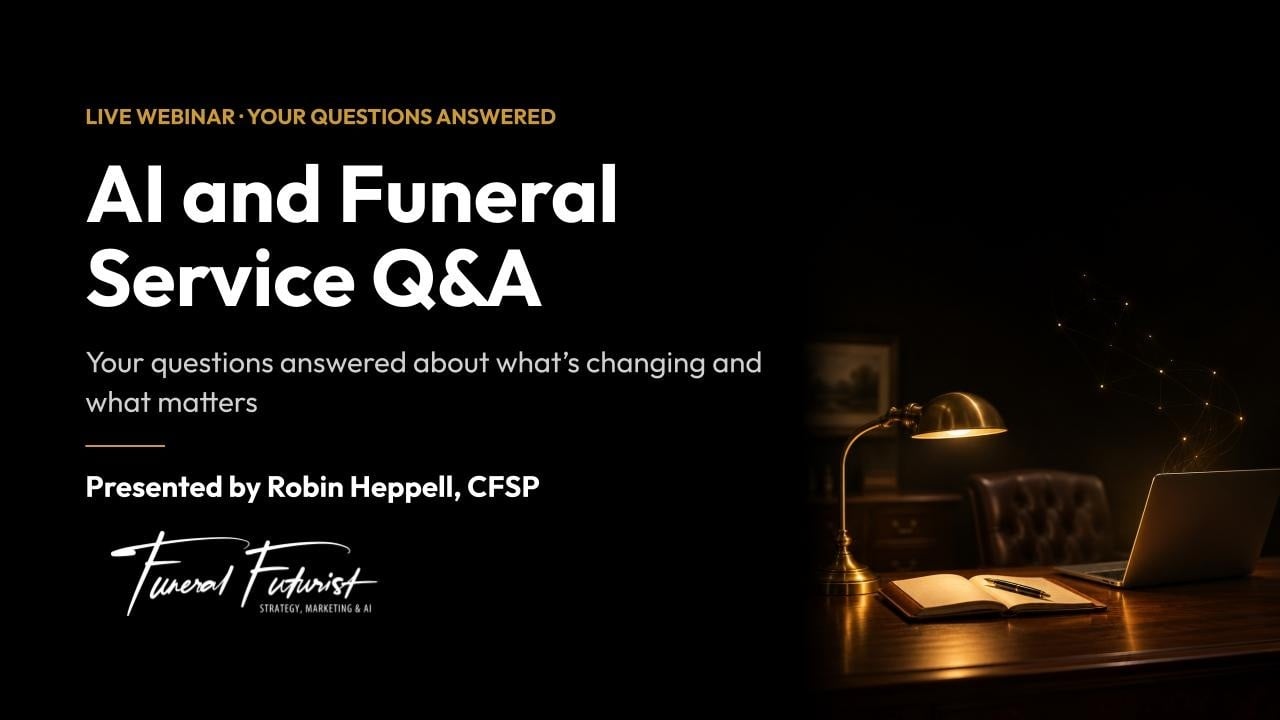
Watch: AI & Funeral Service FAQ
Real Questions. Practical Answers.
Watch the webinar
Join Robin Heppell, CFSP, for a funeral-industry-focused conversation about AI and the questions funeral business owners should be asking.
The objective is to help funeral professionals develop a better understanding of AI without turning the conversation into a demonstration of one particular software product.
What Funeral Professionals Can Learn
This educational guide examines:
- The differences between AI assistants, automation, and AI agents.
- Potential ways AI could support funeral home management.
- Opportunities to reduce repetitive administrative tasks.
- How AI might support family communications and pre-need follow-up.
- The importance of protecting confidential information.
- Why human judgment remains essential.
- How to evaluate AI opportunities without getting caught up in technology hype.
Why AI Matters for Funeral Home Management
Funeral home owners already manage a complicated business environment.
They oversee staff, serve families during difficult circumstances, maintain facilities, manage marketing, coordinate arrangements, monitor financial performance, and plan for the future.
Many of these responsibilities involve repetitive administrative processes.
Others require considerable professional judgment, compassion, discretion, and experience.
Understanding this difference is essential when evaluating AI.
A tool that helps organize internal procedures presents a different set of considerations from a system that communicates directly with a family making funeral arrangements.
The fact that a task can be automated does not automatically mean that it should be.
For funeral professionals, responsible AI adoption begins with a business problem—not a software demonstration.
Three Levels of AI That Funeral Owners Should Understand
The term artificial intelligence covers several different types of capability.
1. AI as an Information Assistant
At its simplest, AI can assist staff with activities such as drafting, summarizing, organizing, and explaining information.
Potential funeral home applications include:
- Drafting internal meeting agendas.
- Preparing initial training outlines.
- Organizing non-confidential administrative material.
- Creating preliminary versions of staff communications.
- Summarizing approved policies for review.
These tasks can still require human verification, particularly when accuracy matters.
2. AI as a Workflow Assistant
AI may also be connected to structured business processes.
For example, a funeral home could evaluate a workflow that organizes a pre-need inquiry, prepares an appropriate follow-up draft, and alerts a staff member when action is needed.
The objective isn’t to replace the person responsible for the relationship.
It’s to support a more consistent process.
3. AI Agents and More Advanced Systems
Some AI systems can use tools and carry out multiple steps toward an objective.
For funeral businesses, this raises interesting possibilities involving scheduling, administrative coordination, and internal information management.
But greater autonomy also creates greater management responsibilities.
Organizations must consider permissions, safeguards, accuracy, monitoring, escalation procedures, and who remains accountable for the outcome.
An AI agent should not be confused with an unsupervised replacement for an experienced funeral professional.
Where Could AI Be Useful in a Funeral Home?
Internal Operations and Administration
One sensible place to investigate AI is behind the scenes.
Consider the amount of time a funeral home spends drafting procedures, organizing records, preparing training materials, and locating information.
Some of this work may be suitable for AI assistance when appropriate information controls are in place.
A funeral home might begin by identifying one recurring administrative task, documenting the existing process, and testing whether AI can assist staff without compromising accuracy or confidentiality.
That is a more controlled approach than attempting to automate an entire department.
Staff Training and Knowledge Management
Funeral homes depend on consistent procedures, yet many operational details live in individual employees’ experience or in documents that can be difficult to locate.
AI-assisted knowledge systems could potentially help staff find relevant information from approved internal resources.
For instance, a manager might want a new employee to locate the proper procedure for an administrative task.
Any AI-generated explanation should remain consistent with the firm’s actual procedures, licensing requirements, and internal policies.
Family Communications
Family communication is one of the most sensitive areas to consider.
An AI system may be useful for providing approved general information, routing inquiries, or alerting staff that someone needs assistance.
But families may also be grieving, confused, anxious, or dealing with complicated circumstances.
These situations call for empathy and professional judgment.
Funeral homes considering AI-assisted communication should think carefully about transparency, accuracy, escalation, and when a human funeral professional must take over.
The goal should be to support personal service, not create additional barriers between families and the funeral home.
Pre-Need Inquiry and Follow-Up
Pre-need programs require organization, timely responses, and consistent attention.
AI and automation may help with administrative aspects of the process, such as organizing inquiries, preparing follow-up drafts, and reminding staff about scheduled actions.
Whether these systems create meaningful improvements depends on the underlying processes, information quality, staff execution, and measurement.
Technology alone does not create trust.
A successful pre-need relationship still depends on understanding the individual and providing appropriate professional guidance.
Marketing and Online Visibility
AI is also affecting how information is created, organized, searched, and presented.
For funeral home managers, this creates questions about the accuracy, usefulness, and visibility of their online information.
A sensible starting point is to maintain clear, current, trustworthy website content that answers the questions prospective families actually ask.
AI can assist with preparing or reviewing content, but factual accuracy and professional standards still require editorial oversight.
What Should Funeral Homes Avoid Automating?
Not every task is suitable for AI.
High-stakes decisions, sensitive communications, confidential information, and situations requiring licensed professional judgment deserve particular care.
Before implementing an AI-assisted process, owners should ask:
- Does this process involve confidential family or employee information?
- Can the information produced by AI be independently verified?
- Who is responsible if the system makes a mistake?
- Is the family aware of any relevant AI interaction?
- Can someone easily reach an appropriate staff member?
- Are we complying with applicable legal and professional requirements?
These questions apply to both small independent firms and larger funeral organizations.
How Should a Funeral Home Evaluate AI?
Rather than beginning with a list of products, begin with a management assessment.
Step 1: Identify the problem. What specific task is consuming time, creating inconsistency, or causing missed follow-up?
Step 2: Understand the existing process. If the current workflow is poorly documented, adding AI may simply create a more complicated problem.
Step 3: Assess the risks. Determine what information the system would use and what errors could mean for staff, families, or the business.
Step 4: Start with a controlled test. Select a manageable use case with clear human oversight.
Step 5: Measure the result. Examine accuracy, staff effort, reliability, and operational value.
Step 6: Reassess regularly. AI capabilities and the products built around them continue to change.
A deliberate approach lets funeral businesses explore opportunities without sacrificing their service standards.
Frequently Asked Questions About AI in Funeral Service
Can AI help a funeral home save time?
Potentially. AI can assist with repetitive tasks such as drafting, summarizing, and organizing information. Actual time savings depend on implementation, the accuracy of results, and the amount of human review required.
Can AI answer a funeral home’s telephone?
AI voice systems can handle some types of calls and inquiries. Funeral homes must evaluate whether the technology is appropriate for particular situations and establish reliable procedures for urgent matters, sensitive conversations, errors, and staff handoffs.
Can AI replace a funeral director?
AI can assist with certain tasks performed in a funeral home. It does not remove the need for licensed professional responsibilities, compassionate care, accountability, or human judgment.
Can AI help with pre-need marketing?
AI may assist with administrative work, communication drafts, lead organization, and follow-up workflows. These activities should support, rather than replace, the relationship between the pre-need professional and the prospective client.
Is it safe to put family information into AI tools?
That depends on the information, the system, applicable law, access controls, contracts, and the firm’s privacy obligations. Confidential information should not be entered into an unapproved AI service without an appropriate assessment and safeguards.
What is the difference between AI and automation?
Traditional automation typically follows defined rules or workflows. AI can also interpret, generate, classify, or work with information. They can be combined, but their reliability and oversight requirements differ.
Should a small funeral home start using AI?
A small firm can investigate AI without committing to a major technology project. Starting with one low-risk internal process provides a way to evaluate usefulness, limitations, and staff acceptance.
How can funeral home managers stay current with AI?
Focus on business-relevant developments, evaluate credible information, test selected applications carefully, and revisit decisions as capabilities change. It is generally more useful to understand underlying management principles than to chase every newly announced product.
The Future of AI in Funeral Service
Artificial intelligence will continue to raise questions for funeral professionals.
Some opportunities will turn out to be genuinely useful. Others will be less effective than the marketing suggests.
The challenge is not to adopt every emerging capability.
It is to develop the knowledge and judgment needed to recognize which developments matter to your particular business.
Funeral service has always required a balance between tradition and adaptation.
The same principle applies to AI.
Technology should help support the quality of service, integrity, responsiveness, and professional relationships that families rely upon.
Continue Learning: AI for Funeral Management
Understanding AI is not a one-time activity.
The opportunities, limitations, and management implications will continue to evolve.
AI for Funeral Management is being developed as an educational resource for funeral home owners and cremation provider managers who want to stay informed and make thoughtful business decisions.
If you would like to be part of the initiative from the beginning, explore founding membership.
AI for Funeral Management is being developed as an educational resource for funeral home owners and cremation provider managers who want to stay informed and make thoughtful business decisions.
If you would like to be part of the initiative from the beginning, explore founding membership.
Book a Strategic Planning Session
If you’d like to look at your own market, case-management process and current website, book a Strategic Planning Session with me:
https://www.FuneralFuturist.com/meet/