
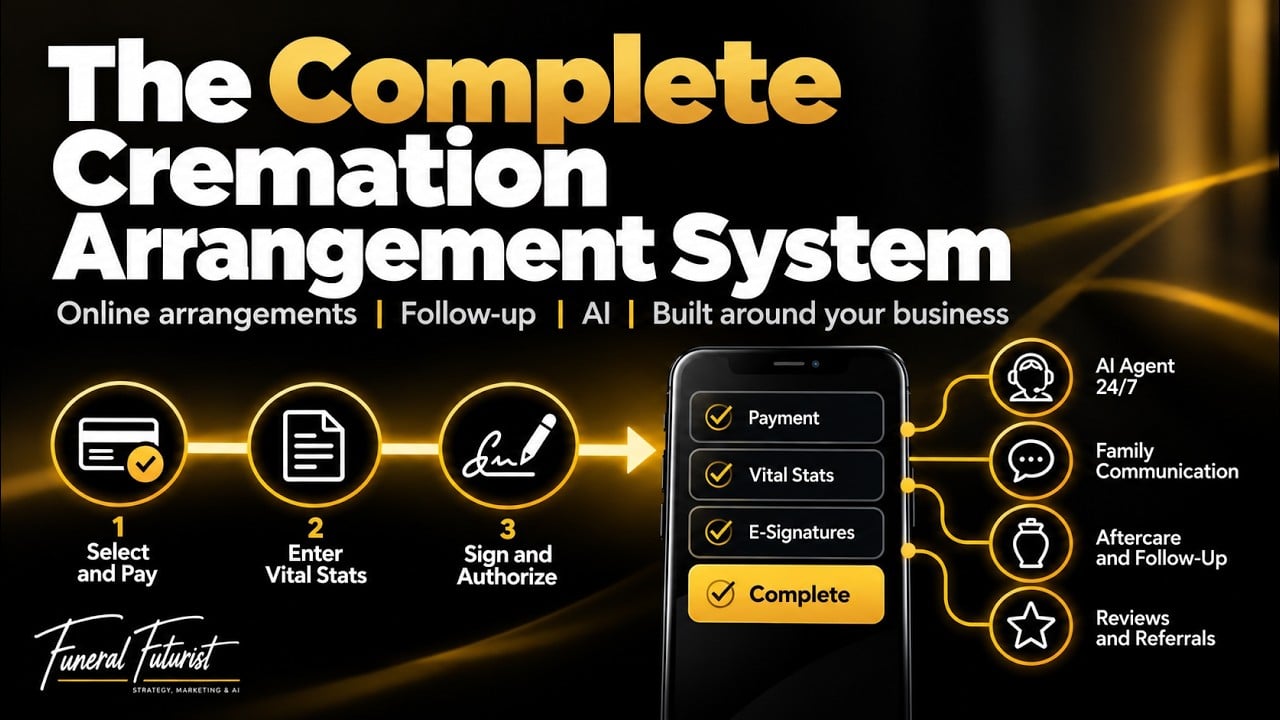
Most online cremation websites were built to answer one question:
Can the family complete the purchase online?
That was a useful first step.
But it is no longer enough.
If the family pays online and your staff still have to chase vital statistics, send authorization forms, answer routine status questions, follow up on the urn and remember to ask for a review, the website has only automated one small part of the arrangement.
A complete cremation arrangement system should continue working after checkout.
Why this matters now
Families increasingly expect to research funeral and cremation options online, compare prices and complete more of the arrangement without an office visit.
That changes the importance of what marketers call speed to lead.
In the webinar, I talked about how differently we used to think about inquiry calls. Years ago, a manager might even tell a funeral director not to call a prospect back too quickly because the firm did not want to appear eager.
That world is gone.
Today, if an online consumer hits friction or cannot get an answer, the next provider is only a click away.
The goal is not to remove funeral professionals from the arrangement.
It is to remove unnecessary friction while still making it easy for the family to reach a person whenever they need one.
Watch the webinar
What you’ll learn
- Why Select and Pay First changes the online arrangement
- How vital statistics can populate authorization forms automatically
- How automated reminders handle unfinished paperwork
- Where AI voice and chat fit into family communication
- How post-arrangement workflows continue family care
- Why ownership of the website and underlying system matters
- How three different setups can fit different funeral homes
1. Start with Select and Pay First
The traditional funeral arrangement normally ends with payment.
For online cremation arrangements, I prefer to reverse the order.
The family first selects the package and options they want and completes payment.
Then they enter the remaining vital statistics and complete the required authorizations.
The practical reason is simple.
I would rather follow up with a family for a missing mother’s maiden name than follow up for their credit card.
Once the family has committed, the remaining process can focus on completing the case rather than completing the sale.
2. Let the family finish the entire arrangement online
A family should not have to complete the same information repeatedly.
In the workflow demonstrated during the webinar, the family enters the vital statistics once.
The system then uses that information to pre-populate the required authorization forms.
Instead of retyping everything, the family receives the completed form through a secure signing process and only needs to complete the remaining choices, initials and signature.
That reduces duplication for the family and administrative work for staff.
3. Let reminders handle predictable gaps
Not every family will finish every step immediately.
That is normal.
The mistake is making staff responsible for remembering every incomplete task.
During the webinar, I demonstrated a workflow in which the system waits after payment to see whether the vital-statistics form has been completed.
If it has not, the family receives a gentle reminder.
The system checks again later.
If the form remains incomplete after the reminder sequence, staff receive an alert so a person can step in.
That is a useful way to think about automation in funeral service:
Automate the predictable part. Bring in a person when a person is needed.
4. Keep merchandise inside the arrangement
Online arrangements should not require families to navigate an enormous digital selection room.
A focused selection is usually easier.
In the webinar, I discussed offering a limited number of cremation containers, urns and keepsakes during the arrangement, then making the broader Arrangement Store available afterward as well.
That creates another opportunity for families who did not select merchandise during the initial transaction without overwhelming the first decision.
5. Make somebody available after hours
A family’s question does not always arrive during office hours.
The Funeral AI Agent can handle web chat and phone conversations around the clock.
It can answer the questions it has been trained to answer, capture contact information, guide a visitor toward beginning an arrangement and alert staff when the conversation needs a person.
The point is not to pretend AI is a funeral director.
It is to make sure the family receives a timely response while preserving a clear path to human help.
6. Continue communication after checkout
The transaction is not the end of the family’s relationship with your firm.
A complete system can support communication such as:
- Family status updates
- Urn pickup
- Review requests
- Family referrals
- Aftercare communication
- Follow-up on merchandise
- A later conversation about a Celebration of Life
Each funeral home can decide which workflows belong in its process.
The important point is that predictable communication no longer needs to depend entirely on staff memory.
7. Think beyond Google Ads
There was a time when a cremation website and Google Ads could do most of the heavy lifting.
Search is more fragmented now.
Funeral homes need to think about local SEO, map listings, reviews, business citations and increasingly the answers consumers receive from AI search tools.
The website, search visibility and arrangement experience should work as one connected system rather than separate marketing projects.
8. Fit the technology around the business
Not every funeral home needs the same implementation.
That is why I presented three configurations.
Select and Pay Only
The family selects and pays online, then the case moves into the case-management process the firm already uses.
Full Arrangement
The website completes all three stages:
- Select and Pay First
- Enter Vital Stats
- Sign and Authorize
Full System
The arrangement is combined with Funeral Clients CRM, family communications, the Funeral AI Agent and the additional workflows.
The right setup depends on the systems you already use, the amount of automation you want and where you want the handoff to occur.
9. Ownership matters
One of my strongest opinions about funeral technology is that the funeral home should retain control of its business assets.
That includes:
- Your domain
- Your website
- Your payment processor
- Your CRM account
- Your families’ information
That is what I mean by:
All-in-one service, not all-in-one lock-in.
The system should make your business more capable, not more dependent.
10. Understand the changing cremation consumer
One trend I discussed in the webinar is what I think of as the hybrid cremation consumer.
Some families are separating disposition from ceremony.
They may choose a lower-cost cremation provider for the physical cremation and later pay a full-service funeral home for a Celebration of Life or memorial event.
That creates both a competitive challenge and an opportunity.
The cremation arrangement should not necessarily be treated as the last transaction with the family.
In some cases, it may be the beginning of a second conversation.
A market-intelligence tool for cremation providers
Near the end of the webinar, I also demonstrated CremationCompetitors.com.
The tool gathers publicly available market information and uses AI to help compare cremation providers across measures such as website quality, reviews, obituary activity and online visibility.
It is intended as a starting point for identifying gaps and opportunities in a local market.
Visit:
https://www.CremationCompetitors.com/
Key takeaways
A modern cremation arrangement website should do more than accept a payment.
It should help the family complete the arrangement, help the staff manage the case and help the business continue communicating after checkout.
The best technology does not remove the funeral professional.
It removes unnecessary friction around the funeral professional.
What to do next
Start with your existing website.
Ask ten questions:
Does payment come first?
Can the entire arrangement finish online?
Are prices immediately understandable?
Is merchandise included?
Are unfinished steps followed up automatically?
Can somebody respond after hours?
Does communication continue after checkout?
Can families find the business online?
Does the technology fit your existing operation?
And do you own it?
If several of those answers are no, you now have a practical roadmap for what to improve next.
Book a Strategic Planning Session
If you’d like to look at your own market, case-management process and current website, book a Strategic Planning Session with me:
https://www.FuneralFuturist.com/meet/
Frequently asked questions
What is an online cremation arrangement system?
It is a system that allows a family to choose and pay for cremation services online and can also manage vital statistics, e-signatures, reminders, family communication and follow-up.
What is Select and Pay First?
Select and Pay First moves payment to the beginning of the online arrangement. The family selects the services and completes payment before moving on to vital statistics and authorization forms.
Can an online cremation arrangement work with an existing case-management system?
Yes, depending on the system. Robin explained that the online arrangement can be configured to hand the case off after payment, and integrations may be possible when the case-management platform accepts incoming information.
Can the entire cremation arrangement be completed online?
Yes. The Full Arrangement setup demonstrated in the webinar includes Select and Pay First, Enter Vital Stats, and Sign and Authorize.
How can automation reduce funeral-home workload?
Automation can handle predictable follow-up such as incomplete forms, unsigned authorizations, family updates, review requests and other scheduled communication.
Can AI answer funeral-home calls after hours?
The Funeral AI Agent demonstrated in the webinar can handle phone and web-chat conversations, answer questions from its knowledge base, capture information and escalate when staff involvement is needed.
Does AI replace the funeral director?
No. Robin positioned AI and automation as tools for handling repetitive or predictable communication while keeping funeral professionals available when human judgment and interaction are needed.
Should a cremation arrangement website offer every urn online?
Not necessarily. Robin recommended keeping the initial arrangement selection relatively focused rather than placing the entire selection room online.
Who should own the cremation website?
Robin’s recommended model is for the funeral home to control its domain, website, payment processor and family data rather than relying entirely on a closed rented platform.
What are the three system configurations?
They are Select and Pay Only, Full Arrangement and Full System.